Table of Contents
Skardu looks simple in travel photos: lakes, forts, deserts, valleys and snow-covered mountains. But once you arrive, you quickly realize that Skardu is not one compact sightseeing area. Its main attractions are spread in different directions, and every route has its own travel time, road condition and planning style.
That is why a Skardu map guide is more useful than a normal list of tourist places. Once you understand the map, it becomes much easier to choose your hotel, plan your transport and avoid unnecessary backtracking.
If you are still getting to know the region, first read our guide to Skardu’s location in Pakistan. For travelers arriving by road, our Islamabad-to-Skardu road guide can help you understand the main entry route before planning local sightseeing.
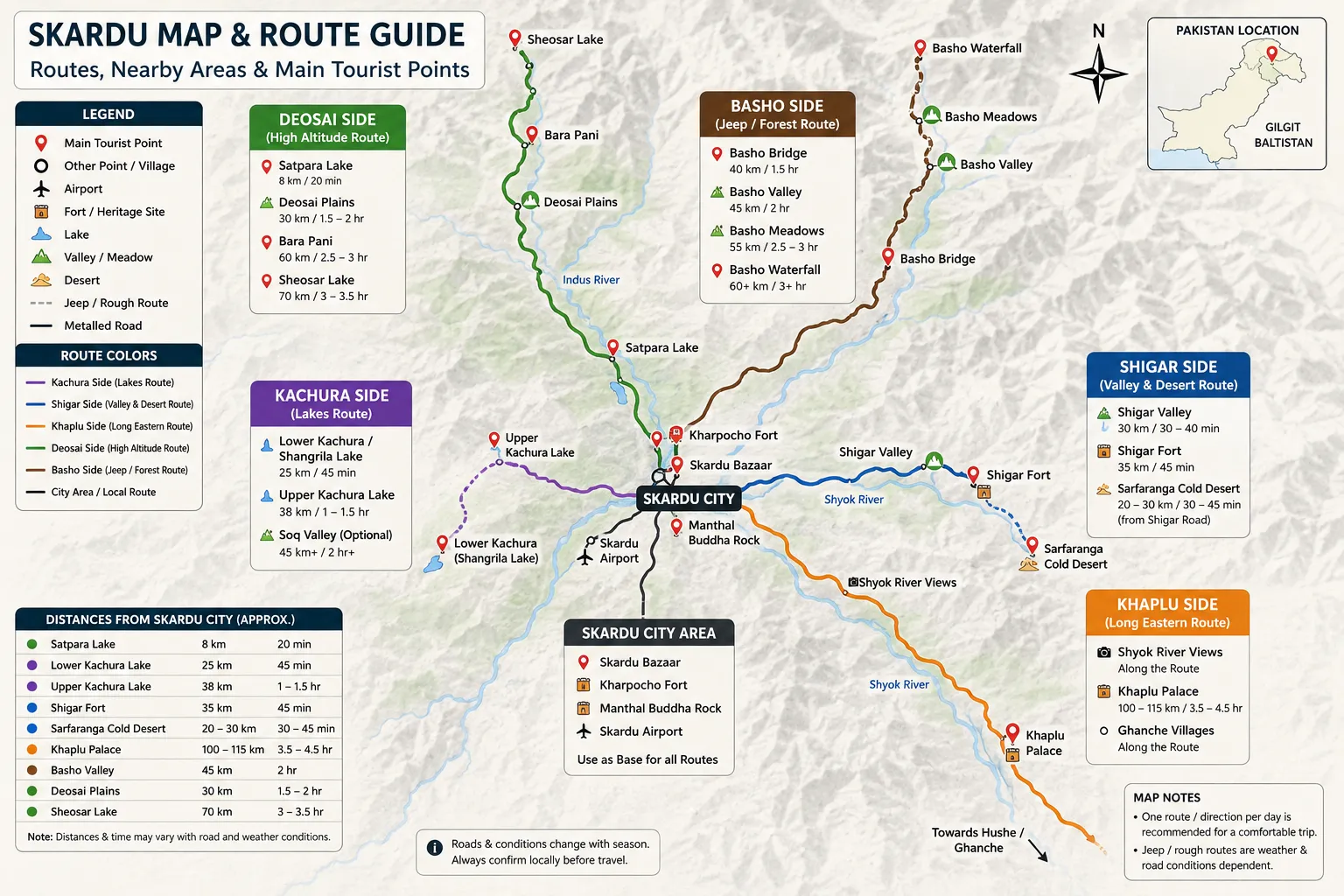
The easiest way to read the Skardu tourist map is to place Skardu city in the centre and imagine the main routes moving outward like branches.
| Route Zone | Direction from Skardu | Best For | Travel Style |
| Skardu City Area | Central base | Arrival day, bazaar, fort, short sightseeing | Easy car access |
| Kachura Side | Lake route | Lower Kachura, Upper Kachura, soft family sightseeing | Easy to moderate |
| Shigar Side | Valley and desert route | Shigar Fort, Sarfaranga Cold Desert, river views | Half-day or full-day |
| Khaplu Side | Longer eastern route | Khaplu Palace, Shyok River, cultural landscape | Full-day drive |
| Deosai Side | High-altitude route | Deosai Plains, Bara Pani, Sheosar Lake | Seasonal, local confirmation needed |
| Basho Side | Forest and jeep route | Basho Valley, meadows, streams, nature scenery | 4x4 recommended |
The main rule is simple: plan one direction per day. Kachura, Shigar, Khaplu, Deosai and Basho are separate route zones. Trying to combine too many of them in one day usually makes the trip tiring.
Skardu city serves as the region’s central base. From here, travelers move toward different valleys and road corridors. Kachura is the easiest lake route; Shigar gives a mix of fort and desert scenery; Khaplu is a longer cultural route; Deosai is seasonal and high-altitude; while Basho is more raw and nature-focused.
Many tourists make the mistake of judging Skardu only by distance. A place may look close on Google Maps, but road conditions, landslides, weather, daylight and jeep tracks can change the full experience. In Skardu, drive time matters more than kilometres.
Before finalizing your plan, check road status, weather, jeep requirements, hotel location and local driver advice. This is especially important for Deosai and Basho, where conditions can change quickly.
Most travelers reach Skardu either by air or by road. Your route of arrival also affects how you should plan your first day.
Skardu Map Guide
The Islamabad to Skardu flight is the fastest way to reach the region. It usually takes around one hour, but mountain weather can affect flight operations. Morning flights are often preferred because visibility can change later in the day.
Skardu International Airport is outside the main city area. If your hotel is in Skardu city, the transfer is usually simple. If your hotel is near Kachura or Shigar, your first move after landing may already put you closer to a specific route zone.
Keep your arrival day light. Hotel check-in, Skardu Bazaar, Kharpocho Fort or a short lakeside visit is usually enough. For more help with first-day planning, read our Skardu arrival guide.
The route from Islamabad usually follows the Karakoram Highway, then connects via the Jaglot–Skardu Road. A common route flow is:
Islamabad → Mansehra/Abbottabad → Besham or Naran side → Chilas → Jaglot → Skardu
The exact route depends on the season. In summer, the Naran–Babusar side may be used if open. In other months, travelers often use the Besham–Dasu–Chilas route. After Jaglot, the road turns toward Skardu through the Indus gorge.
If you are arriving by road, stay in or near Skardu city on your first night rather than pushing toward a distant valley. You can read the full route breakdown in our road to Skardu guide.
Skardu city is the practical base of the valley. It may not be the wildest part of the region, but it is the most useful area for arrivals, departures, food, shopping, transport coordination and short sightseeing.
Main places in and near the city include Skardu Bazaar, Kharpocho Fort, Manthal Buddha Rock, airport access areas, hotels and restaurants.
Skardu Bazaar is useful for snacks, warm clothing, SIM cards, medicine, cash and dry fruit. If you are planning a trip to Deosai or Basho, the bazaar area is also a good place to check jeep availability and ask about current road conditions.
Kharpocho Fort is one of the best places to get a visual sense of Skardu. From this viewpoint, you can see how the valley opens in different directions. Manthal Buddha Rock is another easy cultural stop that fits well into a relaxed city-area plan.
Skardu city is usually the best base for first-time visitors because it offers access to all major directions. It works well for families, elderly travelers and anyone who wants flexible transport, restaurant access and easier day-trip planning.
If your plan includes different routes on different days, the city is usually more practical than staying far inside one valley.
The Kachura side is one of the easiest sightseeing zones on the Skardu tourist map. It is popular because it gives travelers lakes, soft views and relatively manageable access without requiring a very long drive.
The main tourist points are Lower Kachura Lake, Shangrila Lake, Upper Kachura Lake, Soq Valley and the Kachura village area.
Lower Kachura, often known as Shangrila Lake, is the easier lake stop and works well for families, couples and first-time visitors. Upper Kachura feels quieter and more natural, though walking and access conditions should still be checked locally. Soq Valley can be added if time, vehicle and road access allow.
Kachura works best as a half-day or one-day lake route. Avoid mixing it with Khaplu or Deosai unless your plan is very specific.
Shigar is one of the most useful route zones for travelers seeking heritage, desert scenery, and valley views without going too far from Skardu city.
The main places on this side include Shigar Valley, Shigar Fort, Sarfaranga Cold Desert, Shigar River viewpoints and nearby village scenery.
Shigar is better planned as a route rather than just one stop. As you move toward Shigar, the landscape changes from city-side roads to river views, desert patches and traditional settlement areas. Shigar Fort is the main cultural highlight, while Sarfaranga Cold Desert is one of the most popular photography points.
A half-day Shigar plan works if you only want the fort and nearby views. A full-day plan is better if you want desert stops, photography breaks, riverside views and a slower valley experience.
Khaplu sits on the longer side of the Skardu map. It is not usually a rough jeep route, but it takes time because of the distance.
The main highlights are Khaplu Palace, views of the Shyok River, Ghanche-side villages, and roadside viewpoints. The palace is the main cultural landmark, but the drive itself is also part of the experience. Do not treat Khaplu like a quick stop. If you leave late, rush to the palace and return tired, the route loses its value. Khaplu is best planned as a dedicated full-day route from Skardu.
Families can do Khaplu comfortably if they start early and keep the day focused. Avoid combining Khaplu with Deosai or Basho.
Deosai is completely different from Kachura, Shigar and Khaplu. It is a high-altitude seasonal route, so weather and road conditions matter more than normal sightseeing distance.
The main points on this side include Satpara Lake, Deosai Plains, Bara Pani, Sheosar Lake and the Deosai–Astore exit route.
Sadpara Lake is often visited before moving higher toward Deosai. The plains are the main attraction, while Sheosar Lake is farther in and should only be included if time, road, and weather conditions allow.
Deosai is best for travelers who can start early, have a full day, are comfortable with altitude and can adjust their plan if the weather changes. Families can visit in season, but children and elderly travelers may feel the altitude more strongly.
Always confirm local road status before departure. For seasonal access, packing and timing advice, read our Deosai seasonal travel guide.
Basho Valley is one of the most rewarding but less simple route zones around Skardu. It is known for forests, meadows, streams and a more natural mountain feel.
The main points include Basho Bridge, Basho Valley, Basho Meadows, Basho Waterfall and local village tracks.
Basho often involves rough sections, narrow tracks and jeep-style movement. A 4×4 is usually recommended depending on the road conditions. This route is best for nature lovers, photographers and travelers who are comfortable with bumpy roads.
Plan a Basho full-day nature route. Do not add it after a heavy Khaplu or Deosai day. If the weather is unstable or your group dislikes rough roads, keep Basho flexible. For a hassle-free journey, book our Basho Valley tour, in which you don’t have to worry about anything; just sit back and relax and enjoy your trip with your loved ones.
Distances in Skardu should always be treated as approximate, as hotel location, road conditions, stops, and weather can affect travel time.
| Area / Point | Approximate Distance from Skardu City | Route Zone | Planning Style |
| Skardu Bazaar | 0 km | City | Base area |
| Kharpocho Fort | Close city access | City | Half-day |
| Manthal Buddha Rock | Short city-side drive | City | Half-day |
| Satpara Lake | Around 8 km | Deosai side | Short stop or route start |
| Lower Kachura / Shangrila Lake | Around 25–35 km | Kachura side | Half-day/lake route |
| Upper Kachura Lake | Around 30–40 km | Kachura side | Lake route |
| Shigar Valley | Around 30–40 km | Shigar side | Half-day/full-day |
| Sarfaranga Cold Desert | Around 20–35 km | Shigar side | Route stop |
| Basho Valley | Around 40–55 km | Basho side | Full-day/jeep route |
| Khaplu Palace | Around 100–115 km | Khaplu side | Full-day |
| Deosai Entrance Side | Around 30–35 km to upper access area | Deosai side | Seasonal full-day |
| Sheosar Lake | Farther inside Deosai | Deosai side | Full-day seasonal route |
Use this table as a planning guide, not a fixed timing chart. In Skardu, a 30 km mountain route can feel very different from a 30 km city road.
A map-based Skardu itinerary should focus on one direction per day. This keeps the trip smoother and reduces unnecessary driving.
This is not a fixed tour package itinerary. It is a practical route-flow model. If you want a more detailed day-by-day plan, read our Skardu itinerary guide.
Choose your hotel according to your route plan. If most of your sightseeing is around Kachura, staying near Kachura can save time. If you want mixed daily routes, Skardu city is more flexible. If your plan is heavy on Shigar, one night in Shigar can make sense.
Download offline maps before leaving the city. Mobile signals can weaken outside the main city and in valley pockets.
Keep one flexible day if possible. Flights, weather and mountain roads can change quickly, and flexibility prevents stress.
Ask about road status locally, especially for Deosai and Basho. Do not rely only on old online reviews or map distance.
Pack according to your route, not just the month. Even in summer, Deosai can feel cold and windy. Basho may involve rough tracks. Kachura is usually softer and easier.
The most common mistake is trying to cover too many directions in one day. Kachura, Shigar, Khaplu, Deosai and Basho are separate route branches. Combining too many of them turns the day into driving instead of traveling.
Another mistake is trusting distance more than drive time. Mountain roads are not measured only in kilometres. A short, rough route can take longer than a longer, smoother one.
Many travelers also book hotels only because the view looks beautiful online. A hotel can be scenic but inconvenient if it is far from your planned routes.
Ignoring altitude is another issue. Deosai is high-altitude, and even if the distance looks manageable, wind, temperature and oxygen level can affect comfort.
The best way to plan your trip to Skardu is to choose your route zones first, then choose your hotel and transport. Do not start with a random list of attractions. Start with the map.
For first-time visitors, Skardu city is usually the easiest base because it offers access to all major directions. From there, plan one route per day: city area for arrival, Kachura for lakes, Shigar for fort and desert, Khaplu for culture, Deosai for a seasonal high-altitude day and Basho for forests and jeep-route scenery. A map-based plan saves time, reduces backtracking and makes your Skardu trip smoother.
The main tourist areas on the Skardu map are Skardu city, Kachura side, Shigar side, Khaplu side, Deosai side and Basho side. Each area faces a different direction, so it is better to plan Skardu by route rather than make a single mixed list of places.
Places near Skardu city include Skardu Bazaar, Kharpocho Fort, Manthal Buddha Rock, airport access areas and nearby hotels and restaurants. Satpara Lake is also a short-distance stop on the Deosai side.
Deosai may look close on the map, but it is a high-altitude seasonal route. Road condition, weather and vehicle suitability matter. Always confirm local access before planning a trip to Deosai.
The Kachura side is usually one of the easiest Skardu routes for families because it offers lake views, a shorter travel time, and softer sightseeing. Skardu city and Shigar can also work well for families.
It is possible to rush both, but it is not recommended. Shigar works well as a half-day or full-day route, while Khaplu needs a dedicated full-day plan. For a better experience, keep them on separate days.
Access to Basho Valley can involve rough tracks, and a 4×4 or local jeep is often recommended, depending on road conditions. Always confirm the current route before leaving Skardu.
For first-time travelers, Skardu city is usually the easiest base because it gives flexible access to Kachura, Shigar, Khaplu, Deosai and Basho. If your plan focuses mainly on lakes, Kachura-side stays may work better.
The biggest mistake is assuming that all tourist points are close because they appear near each other on the map. In reality, Skardu’s attractions are spread across different valleys and mountain routes.

Saba Ghani is Senior Content Editor at Pakistan Tour and Travel. With expertise in travel writing, she creates inspiring content that connects with audiences. Reach her at saba@pakistantourntravel.com or Twitter






12 Years of Tourism Services - DTS License # 8135