Travel Guide to Land of Gaints
Deosai - Pakistan’s Majestic Plateau

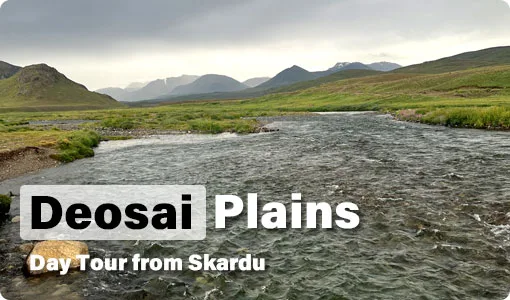
Deosai National Park is shared between the Skardu and Astore districts of northern Pakistan. It covers around 3,000 square kilometers of untouched alpine meadows, crystal-clear streams, and mirror-like lakes. The word Deosai literally translates to “the Shadow of the Giant,” a name that perfectly captures the mysterious, almost mythical feel of this highland wonder. For those who have seen it, Deosai feels like another planet, vast, silent, and timeless. What makes it so special is how quickly it changes with the seasons. In winter, it disappears under a thick blanket of snow, turning into a frozen desert that’s cut off from the world. But when summer comes, it transforms into a lush paradise filled with wildflowers, sparkling streams, and grazing animals. It’s no wonder travelers call it one of Pakistan’s most surreal landscapes.

Check All
Best 5, 7, 9 & 11 Day Deosai Tour Packages
How High is Deosai Plateau?
Altitude and Geography
Sightseeing Deosai National Park Tour Starting from 110,000/-pkr
Deosai is located at an average elevation of over 4,000 meters above sea level, making it the second-highest plateau in the world after Tibet. Its geography is a fascinating mix of rolling meadows, snow-fed lakes, and rugged mountain views stretching as far as the eye can see.
The park covers more than 3,000 square kilometers, larger than some entire countries, and the Karakoram and Western Himalayas border it; the combination gives Deosai its dramatic scenery and constantly changing weather.
Unlike the steep valleys of Skardu, Deosai’s landscape is open and expansive, with soft green slopes that turn golden in the afternoon sun. Several rivers cut through the plateau, including Bara Pani and Kala Pani, both of which eventually feed into the mighty Indus River. The centerpiece of the region is Sheosar Lake, a stunning body of water surrounded by snow peaks that reflect perfectly on calm days.
Because of its high altitude, oxygen levels are lower than in cities, and the weather can shift within minutes from sunny to cloudy, warm to icy cold. That’s part of what makes Deosai both challenging and magical for travelers.


How to Reach Deosai from Skardu
Deosai is located in Gilgit-Baltistan, northern Pakistan, between the Skardu and Astore districts. It lies on the boundary of the mighty Karakoram and Western Himalayan mountain ranges. This high-altitude plateau covers over 3,000 square kilometers, stretching across vast meadows, rivers, and rolling hills. The easiest way to imagine its location is as a massive green roof above Skardu, an open space where the earth meets the clouds.
Because of its position, Deosai connects two of Gilgit-Baltistan’s most scenic valleys, making it a perfect detour for travelers exploring both sides. It’s about a 2-3 hour jeep ride from Skardu city, or around 3-4 hours from Astore via Chilam Chowki. The nearest airport is Skardu Airport, which now has direct flights from Islamabad, making Deosai more accessible than ever before.
Reaching Deosai from Skardu is an adventure in itself. The journey takes about two to three hours by jeep and offers breathtaking views at every turn. The road starts from Skardu city, passing through Sadpara Lake, a serene turquoise lake surrounded by mountains.
From there, the road ascends steadily upward through rocky tracks and alpine slopes until you reach Bara Pani, which marks the start of Deosai National Park. The route is rugged but incredibly scenic, filled with panoramic views, glacial streams, and grazing yaks. Book our Deosai Tour and get an experienced local drivers who know the routes well and often act as an informal guide. It’s best to start the trip early in the morning so you can reach the plains before sunset and set up camp in daylight.
Things to Do & Top Places in Deosai
Deosai is more than a sightseeing spot; it’s a complete outdoor adventure. It is filled with natural wonders, each with its own charm. Here are a few things to do and places you can visit while you are exploring Deosai Plains with your loved ones or alone.
Sheosar Lake is the crown jewel of Deosai. At an altitude of 4,142 meters, it’s one of the highest lakes in the world. On clear days, the reflection of snow-covered Nanga Parbat glows across its surface, making it one of the most photographed spots in Pakistan.
Kala Pani and Bara Pani are two river crossings along the Deosai route, famous for their scenic views and camping potential. The sound of rushing water, distant mountains, and herds of yaks grazing nearby create an unforgettable scene.
Shatung Nala is another gem, an ideal spot for trout fishing and nature walks. Its clear water and green surroundings attract both trekkers and photographers.
Chakaar is known for its wildlife. This is where you’re most likely to see marmots sunbathing or bears wandering at a distance during early mornings or late evenings.
Camping here is one of the best experiences in northern Pakistan. With no city lights, the night sky turns into a sea of stars. The Milky Way is visible to the naked eye, and the silence around is almost unreal.
For photographers, Deosai offers endless opportunities. Whether it’s capturing the golden marmots, mirror-like Sheosar Lake, or the dramatic sunrise over the meadows, every frame tells a story.
Bird watchers can spend hours spotting eagles, vultures, and rare Himalayan birds. Those interested in fishing can try their luck in Shatung Nala, which is home to plenty of trout.
And if you’re into stargazing, Deosai is unmatched. Its high altitude, clean air, and lack of pollution make it one of the best places in Pakistan to observe the night sky. Each corner of Deosai feels untouched and pure, perfect for anyone who loves raw, natural beauty.
What are the rare animals and flora & fauna found in the Deosai plains?
Despite its cold and harsh climate, Deosai is alive with wildlife. It’s one of Pakistan’s richest ecological zones and home to several rare and endangered species. The most famous among them is the Himalayan Brown Bear, a species that was once near extinction. Thanks to conservation efforts, the population has slowly recovered, and spotting one in the wild has become a highlight for many visitors.
Other animals that roam the plains include the elusive Snow Leopard, Red Fox, Himalayan Ibex, Markhor, and Golden Marmot. You’ll often see marmots popping out of their burrows near Bara Pani, curious and unbothered by tourists.
Deosai is also a haven for birdwatchers. The skies here are filled with Lammergeiers, Griffon Vultures, Falcons, and the colorful Himalayan Monal. During the summer months, migratory birds visit the lakes and streams, turning the plateau into a paradise for wildlife photographers.
In July and August, Deosai’s meadows burst into color as wildflowers bloom across the landscape. Blue poppies, buttercups, and daisies cover the fields, making it feel like a natural garden spread out under the clouds.

Frequently Asked Questions About Deosai Plains
Is Deosai safe for solo travelers?
Yes, it’s absolutely safe. However, hiring an expert tour operator or guide is always a better option if you are unfamiliar with the area.
Can I visit Deosai in winter?
No. The park is closed from October to May due to heavy snow and blocked roads.
Is there any entry fee for Deosai National Park?
Yes, visitors, both locals and foreigners, must pay 200 rupees for a Giglit local, 500 rupees for a Pakistani local, and 500/- rupees for a foreigner at the park checkpoints.
Is Deosai suitable for families?
Absolutely. Families often visit Sheosar Lake and Bara Pani for day trips, picnics, and light hikes.
What should I pack for Deosai?
Warm clothes, trekking shoes, camping gear, food, water, sunscreen, and a camera are essential. Nights can get very cold, even in July.